

It can be tiring to agree automatically, hide an interest or accept plans you do not want because you fear disappointing someone. Finding your own voice starts with noticing those moments and making room for your preferences.
You do not need to uncover one fixed, perfect version of yourself. People grow and behave differently in different settings. The aim is to have more choice about what you share, agree to and change.
On this page
Notice where your preferences disappear
Think about a recent invitation, conversation or request. What did you want? What did you say? If the answers differed, what made it difficult to express your preference?
Perhaps you wanted a quiet evening but offered to host. Perhaps you laughed along with a comment you disliked. Write down one example without turning it into a verdict that you are weak, dishonest or have no identity.
Context matters. Adjusting your language at work, keeping something private or staying quiet for safety can be a considered choice. You do not owe everyone the same access to your thoughts.
Turn values into small, specific choices
Choose two or three things you want more room for, such as creativity, faith, friendship, learning or rest. Then connect each to an action you can realistically take this week.
If you value creativity, you might spend twenty minutes on a project you enjoy. If you value friendship, you could suggest a plan you would like rather than waiting to be included. A small action can tell you more about your preferences than a demand to reinvent your whole life.
Your choices may be limited by money, health, care responsibilities or time. Work with the options available. Having constraints does not mean that your values are less real.
Practise a response that leaves you room
Start with an ordinary, lower-pressure situation. You could say, “Let me check before I agree,” “I’d prefer somewhere quieter,” or “I can help for an hour, but I can’t organise the whole event.”
A pause can help when yes has become automatic. You can also offer an alternative if you genuinely want to. An alternative is an option, not a fee you must pay for declining.
If you previously agreed, be clear about any change and its practical effect: “I said I could host, but I can’t manage it this weekend. I’m sorry for changing the plan. Could we choose another arrangement?” Respecting yourself can include acknowledging inconvenience to others.
Allow compromise without losing your say
Being yourself does not require refusing all feedback or always putting your preferences first. Relationships involve listening, shared responsibilities and decisions that affect other people.
Ask whether you can discuss the decision freely. Can you disagree without humiliation? Does compromise sometimes go both ways? Are you agreeing because the arrangement seems workable, or because a refusal feels dangerous?
Someone asking you to stop an insulting joke is different from someone demanding that you abandon your friends, interests or beliefs. Consider the behaviour and its effect rather than treating every request for change as rejection of who you are. The love is respect guide to boundaries can help you think through personal limits.
Choose support and protect your privacy
Spend time, where possible, with people who can hear a preference without requiring you to justify your worth. A friend, trusted relative, community group or qualified counsellor may offer space to explore what you want.
You can share gradually. You do not need to disclose an identity, belief or private experience before you are ready, especially where doing so could affect your safety, housing or support.
If expressing a limit brings threats, monitoring or punishment, consider individual safety support rather than pushing yourself into a confrontation. Finding your voice can begin privately, with a plan and someone trustworthy beside you.
Read the infographic in text
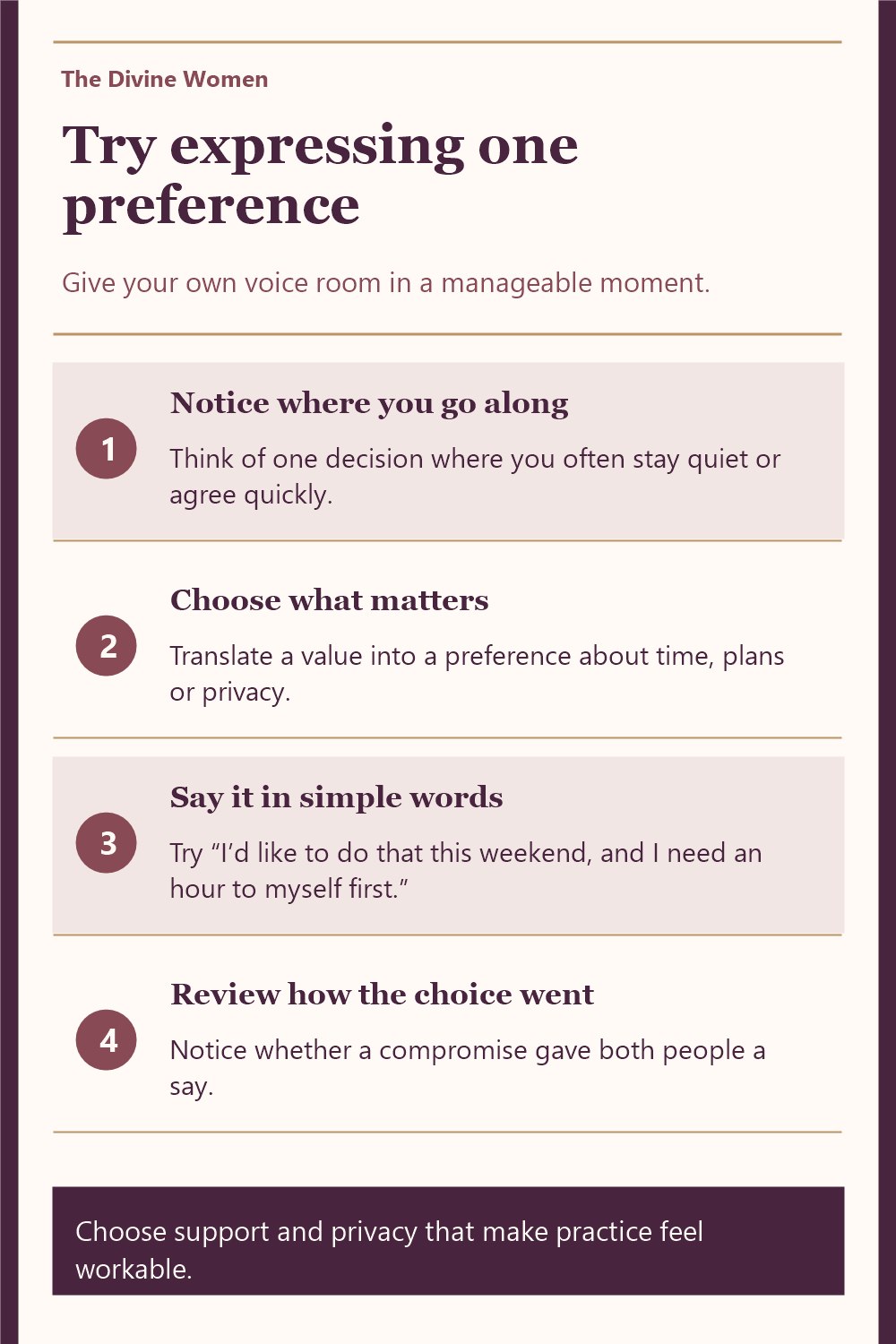
Try expressing one preference Give your own voice room in a manageable moment.
- Notice where you go along Think of one decision where you often stay quiet or agree quickly.
- Choose what matters Translate a value into a preference about time, plans or privacy.
- Say it in simple words Try “I’d like to do that this weekend, and I need an hour to myself first.”
- Review how the choice went Notice whether a compromise gave both people a say.
Choose support and privacy that make practice feel workable.