

You can ask for rest, privacy, support or clearer plans without presenting the need as a mistake. A useful request makes the situation understandable and gives the other person something specific to respond to.
Being considerate does not require making yourself invisible. At the same time, naming a need does not guarantee that one particular person can meet it in the way you first suggest.
From an unspoken need to a clear request
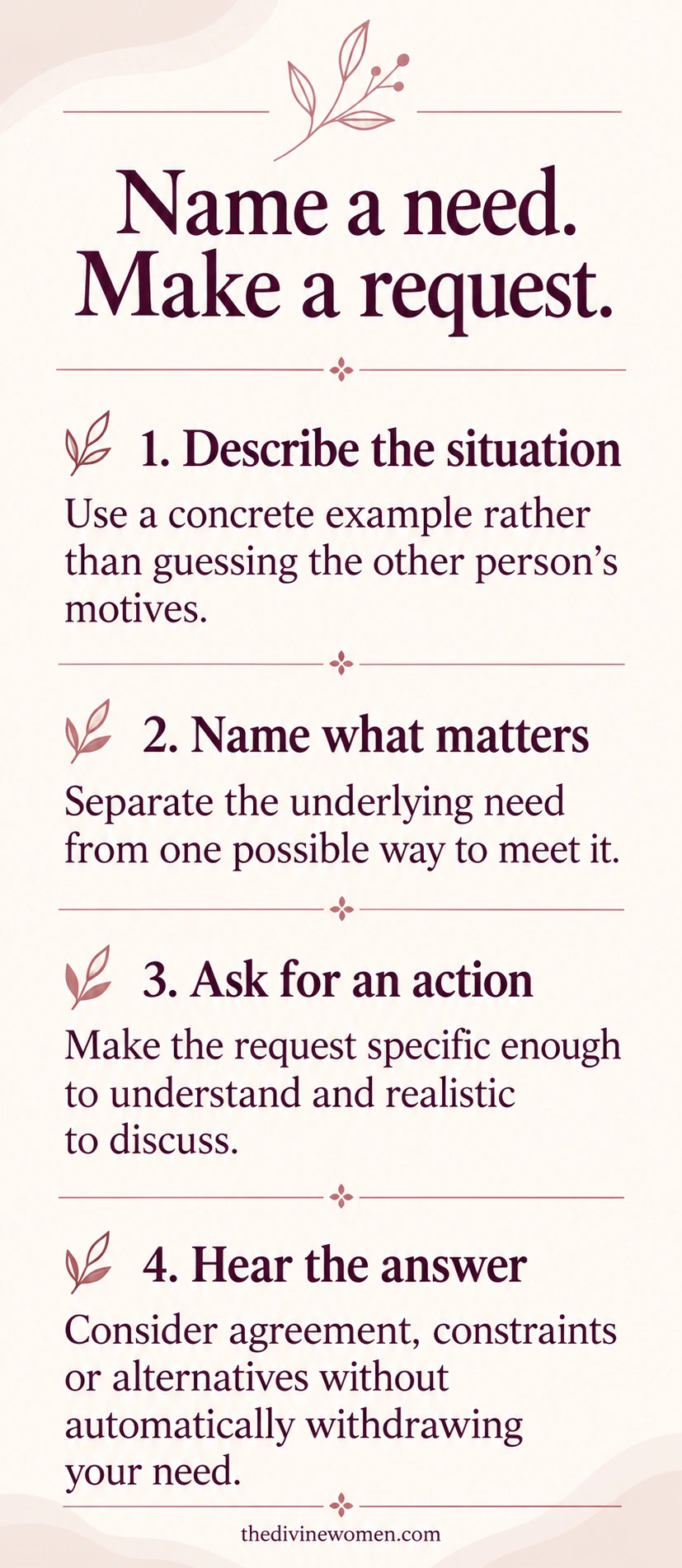
Read the guide as text
- Describe the situation. Use a concrete example rather than guessing the other person’s motives.
- Name what matters. Separate the underlying need from one possible way to meet it.
- Ask for an action. Make the request specific enough to understand and realistic to discuss.
- Hear the answer. Consider agreement, constraints or alternatives without automatically withdrawing your need.
Pay Attention to Your Apologies
Listen for times when you say sorry for asking or for declining an invite. An apology can be helpful when you’ve caused hurt, broken an agreement, or need to acknowledge a mistake. This serves a different purpose than making a request.
If you apologize when you ask a partner to turn down the television when you’re on a work call, then this is an issue with your shared space and nothing you are doing wrong. You could try saying something like, “I have a call until four; could you use headphones?” This makes the request clear.
You don’t need to make sure that you police every word that you said. Start by looking at the situation. A habit that you learned throughout your years might change slowly, and kindness to yourself is more useful than being embarrassed about the way that you speak.
Complain Vs. Need
A complaint usually says something you don’t like, such as, “You’re always changing plans.” The need can be said, but it doesn’t give enough information to plan change. Instead, ask, “What could be different and work better?” The answer then can say what you need without you having to prove someone else’s needs or motives.
You can say something like, “I need to know what our plans are for the weekend by Thursday so I can make sure that I have my time cleared.” This is better than saying, “I need you to care more about me,” and care matters, but it isn’t a practical way to express your needs.
The translation doesn’t mean that you are turning harm into something small, and if you feel scared, threatened, or controlled, then this needs the right kind of support. Saying what you need should never turn an unsafe situation into a regular disagreement.
Finding a Solution After the Need
A need and strategy are related, but they are different. You might need a connection and ask your partner to call you in the evenings. Another kind of connection, though, could be having a longer conversation on certain days and smaller conversations on other days.
Being flexible doesn’t mean that your needs are ignored, but it means that you are finding what realistically works for everyone. Some needs have less room to negotiate and shouldn’t be considered in a different way, such as safety, consent, or respect.

One private question you can ask is, “What part matters to you the most?” If the answer is being told the information, then getting a shared calendar might help. If the answer is that you need to feel valued, this is a different need. Seeing the difference stops a regular request from having an emotional expectation that never gets explained.
Use Regular Sentences
You don’t need to make long speeches to say what you need. Name the situation, what you need, and what you’re asking. You can say something like, “When the plans change late, I can’t arrange a pickup, and I need to have more notice. Can you tell me by Wednesday?”
Assertive communication makes your position clear while respecting the other person’s rights and choices.
Replace a broad request such as “Please support me” with a specific action: “Could you be responsible for dinner on Tuesday?” This makes the next step more clear.
Talk in a way that sounds natural and don’t just rehearse a speech. The best part is that you’re telling your actual needs instead of accusing someone or trying to drop a hint or apology.
Making Your Request Understood
A good request gives an action and a timeframe. Don’t require someone to read your mind or to change your feeling because you tell them to. You can say something like, “Please tell me if you are going to be more than fifteen minutes late.” This is an action sentence over saying something like, “Make me feel better and secure at all times,” which is something no one can guarantee for you.
Check if you’re asking for something that is in the person’s control. They might be able to listen, share information, or follow an agreed plan, but they can’t promise that you aren’t ever going to be uncertain.
If you ask a friend to check before they give you advice when you share a hard day, the friend can do that, but asking them to know if the advice is wanted is a guessing game over a clear agreement.
Making Sure You Don’t Reduce Yourself
You can say that you would appreciate something or that you could do something with them without making the request seem unreasonable or strange. Having clear communication doesn’t mean you have to be harsh.
Look at the difference between saying, “Sorry if this annoys you, and this probably doesn’t even matter but…” and “I would like to talk about something that would make our evenings easier.” The second sentence is what gives room for the topic to exist.
Don’t describe yourself as being too dramatic, difficult, or needy before the person has even heard what you’re asking. These things that you say about yourself can distract you from what you’re asking.
If you like to have a soft communication, then the goal isn’t to replace your personality with more confidence, but it’s to let go of the assumption that your needs aren’t as important as someone else’s.
Pick the Right Time to Talk About What You Need
When you need to talk with your partner about something important, the timing of the conversation can make a difference. For example, bringing up a problem when someone is rushing out the door for work or trying to finish something important might not give either of you a chance to talk things through. If the situation isn't urgent, try picking a time when you're both able to pay attention and have a conversation without feeling rushed.
Sometimes simply asking when would be a good time to talk can help. You might say something like, "Can we talk about our plans for the weekend after dinner?" or "I'd like to figure out how we can make our mornings a little easier. Could we talk about it tonight?" This lets your partner know what you want to discuss without making them feel that they have to stop everything they're doing.
It's also helpful to give your partner a little idea of what the conversation will involve. You don't have to explain everything ahead of time, but letting them know the general subject can make the discussion feel less unexpected. For example, if you're feeling overwhelmed by household responsibilities, you might say, "I want to talk about how we're dividing things around the house because I've been having a hard time keeping up."
But remember that finding a good time to talk doesn't mean waiting forever. Life gets busy, and there might never be a perfect moment when both people are completely relaxed and have nothing else going on. If something is important to you, it deserves attention. The goal is to find a reasonable opportunity to talk instead of putting your needs aside because the timing never seems right.
It's also important to recognize that not every relationship is safe for these kinds of conversations. If you're afraid that bringing up a concern could lead to threats, violence, or other harmful behavior, consider getting private support from someone who understands abusive relationships before approaching the subject. You shouldn't have to find the perfect words or timing to prevent someone else from mistreating you. Your safety matters more than trying to make a difficult conversation go smoothly.
Give Your Partner a Chance to Respond
When you've finally worked up the courage to ask your partner for something, it can be tempting to keep talking after you've made your request. You might start explaining why it isn't a big deal, offer to handle everything yourself, or tell them that it's okay if they can't help. Sometimes this happens because you're nervous about how they'll respond or don't want to make them feel pressured. But constantly changing your request before they've answered can make it harder for them to understand what you actually need.
Instead, try explaining what you're asking for and then giving your partner a chance to respond. You don't have to fill every quiet moment or immediately offer another solution. Sometimes people simply need a little time to think about what you've said before answering.
It's also important to pay attention to the answer you're getting. Maybe your partner agrees to help, or maybe they explain that they can't take on another responsibility right now. They might also be unsure or have a practical concern that needs to be worked out. These responses don't all mean the same thing, and understanding the difference can help you decide what to do next.
For example, imagine you have been feeling overwhelmed with household chores and ask your partner to start handling dinner a couple of nights each week. They might agree right away, or they might explain that their work schedule makes cooking on certain evenings difficult. Instead of assuming they don't care about your needs, you could discuss whether another arrangement would work better. Maybe they could cook on their days off or take responsibility for grocery shopping instead.
Of course, there might also be times when your partner simply doesn't want to do what you're asking. While that can be disappointing, it doesn't automatically mean that your request was unreasonable. You can still recognize that your needs are important while understanding that the other person has the right to make their own decisions.
If you can't find an arrangement that works for both of you, you might need to look for another way to meet your needs or think about what that difference means for your relationship. Sometimes disagreements can be worked through with a little flexibility, while others reveal bigger differences in what each person is willing or able to offer.
The important thing is remembering that communicating your needs doesn't mean that your partner has to agree to everything you ask. A healthy relationship should give both people the opportunity to express what they want, explain their concerns, and make decisions without feeling forced. When you're both able to speak honestly and listen to each other's answers, it becomes easier to understand what your relationship can realistically provide and where changes might be needed.
Looking at Alternatives
If the first request doesn’t work, then go back to the real need. Ask questions like “what could meet this need?” If a partner cannot collect a child because of a work change, discuss a suitable alternative consistent with the child’s care arrangements. Clarify who will make and confirm that plan. The best answer is based on the situation itself.
An alternative should help to make the problems less instead of moving all of the responsibility back to you. You can say something like, “Remind me each morning and I might be able to help,” and this might not meet the need for sharing the responsibility.” You can also take time before you agree to something. You can say something like, “I need to think about if this is going to work for me or not.” Compromising right away isn’t the only way that you’re reasonable.
Guilt and Taking Action
If you’re used to doing what others need, asking clear questions for yourself might be uncomfortable even if you ask considerately. Discomfort can happen because of unfamiliarity, comparing different values, or fear of disappointing someone.
The Centre for Clinical Interventions provides self-help resources for practising assertive communication. Learning a new communication habit often involves trying it before it feels natural.
Ask if guilt is showing a certain action you want to repair or is just the fact that someone might not like your answer. These are completely different questions. You can care about someone’s disappointment without taking responsibility for removing it. A friend might wish you could go to an event with them, but you can still have a need to rest. Look at both instead of turning the feeling into evidence that you should always say yes.
Pay Attention When Your Feelings Keep Getting Dismissed
Sometimes when you're trying to explain something that's bothering you, your partner might not understand what you're asking for right away. That doesn't automatically mean they don't care about your feelings. There might be times when you need to explain something differently or give them a little more information. But there's a big difference between someone who doesn't understand your needs and someone who repeatedly ignores them, makes fun of your feelings, or refuses to discuss making any changes.
If you find yourself constantly being told that you're too demanding, too sensitive, or asking for too much, it might be time to look at how your relationship handles each person's needs. For example, does your partner expect you to respect their preferences without questioning them, but make you explain and defend every little thing you ask for? A healthy relationship should allow both people to express what they need without feeling that their concerns are less important than the other person's.
It's also important to recognize when a conversation stops being productive. If your partner begins insulting you or making hurtful comments, you don't have to continue arguing just to get your point across. You might say something like, "I'm willing to talk about how we can work this out, but I'm not going to keep having this conversation while you're insulting me." When it's safe to do so, stepping away from a disrespectful conversation can help you protect your boundaries without making the situation worse.
But remember that not every relationship problem can be fixed by finding better words. If your partner repeatedly threatens you, pressures you into doing things you're uncomfortable with, or makes you afraid to express your feelings, the situation is more serious than a communication problem. In these circumstances, getting private support from someone who understands abusive relationships can help you think about your safety and available options.
You shouldn't have to explain your needs perfectly before someone treats you with respect. No matter how carefully you word a request, you can't force another person to care about your feelings or take responsibility for their behavior. Both people have to be willing to listen and make an effort for communication to improve.
Start by Speaking Up About the Little Things
If you're not used to asking for what you need, speaking up can feel uncomfortable at first. You might worry about disappointing someone, creating an argument, or seeming difficult. One way to become more comfortable expressing yourself is to start with small, everyday situations where the decision isn't especially serious.
You might practice speaking up when deciding where to eat, what time to meet someone, or how long you want to stay at a family gathering. You could also ask for a little quiet time when you're feeling overwhelmed or explain that you'd prefer to do something differently. These might seem like small things, but they can help you become more comfortable being honest about your preferences.
For an illustrative example, imagine Stephanie and her boyfriend, Chris, deciding where to go for dinner. Stephanie usually tells him that she's fine with eating anywhere, even when she knows that certain restaurants don't have many options that work with her dietary needs. She doesn't want to seem picky, so she stays quiet and often ends up disappointed with the meal.
After realizing that this keeps happening, Stephanie decides to be more honest about what she needs. The next time they make dinner plans, she says, "I'd really like to go somewhere that has something I can eat. I was thinking we could try one of these two places." Instead of expecting Chris to figure out what she wants, she gives him a couple of options that would work for her.
This is a simple example of how expressing your needs doesn't have to involve an argument or a serious conversation. Sometimes it just means being honest about what you prefer instead of automatically agreeing with everyone else.
It's also important not to treat these small conversations like secret tests to see whether someone truly cares about you. The purpose is to practice expressing yourself clearly, not to judge the other person's feelings based on whether they agree with every request. Sometimes they might have a different preference, and that's okay. What matters is that you're becoming more comfortable speaking up and allowing both people to have a say.
Afterward, think about whether you explained yourself clearly and stayed honest about what mattered to you. You don't have to sound perfectly confident or get the exact answer you wanted for the conversation to be successful. Even if you felt nervous or stumbled over your words, speaking up about something that matters to you is still progress.
Remember that learning to express your needs can take time, especially if you've spent years putting everyone else's preferences before your own. Starting with smaller situations can help you build confidence and make it easier to have more important conversations as time goes on. The goal isn't to get everyone to agree with you. It's to become comfortable expressing what you need while respecting that other people have needs and preferences of their own.
Adding Your Own Needs
A friend, partner, or relative might be important to your life without having to give every kind of care you need. Some needs can be supported better with professionals. You might need to talk to friends to embrace your hobbies, a medical team for your health, and counseling for emotional needs. These kinds of support work together.
This doesn’t mean that you should be neglected or that you should accept a friendship or relationship that doesn’t support you, but it can help you identify which conversations and sources of support fit each need.
Saying what you need shows that the answer might need different people for support or might need a change in your routine. You have the right to decide if the relationship gives you enough of what matters to you.
Starting with a Conversation
Write out a sentence in a few short lines such as, “The situation is…,” “What matters to me most is…” “My requests are…” And “If that isn’t possible, then these are the things I need to consider.”
Then turn them into natural sentences, get rid of the apologies that say that you did something wrong, and keep apologies that address what you really did. Practice once, pick a reasonable moment, and then let the conversation happen even if it's not perfect. You can go back to the topic later or clarify your sentences.
You don’t have to be fearless before you tell what you need. You can still be unsure, considerate, and clear all at the same time. Asking honest questions and giving honest requests allows people to understand you better while also helping you to make choices that help your own well-being.
Choose words for a clear request
Choose the need you want to discuss for a concrete sentence and a question to help you adapt it.
You can name a need while still hearing constraints or alternatives. If making a request brings threats or fear, seek private support.
Use the questions and examples in the article above; the draft builder needs JavaScript.
15 questions readers ask
1. Is it selfish to name a need?
Naming a need makes it available for discussion. It does not automatically put it above someone else’s needs or oblige them to agree.
2. Should I stop saying sorry entirely?
No. Apologise when you want to acknowledge harm, a mistake or a broken agreement. Asking for ordinary consideration does not always require an apology.
3. What is the difference between a need and a request?
A need describes what matters, such as rest or reliable information. A request proposes an action that might meet it. Other workable strategies may exist.
4. Can you give a clear example?
“I have a work call until four and need a quiet room. Could you use headphones until then?” It explains the situation, need and requested action.
5. What if I do not know what I need?
Start with a recent situation and what made it difficult. Ask what would have helped, then separate practical information from assumptions about motives.
6. How specific should I be?
Name an action and a useful timeframe where relevant. A person can discuss a task or notice period more easily than a demand to make you feel secure at all times.
7. Can I speak gently and still be clear?
Yes. Directness does not require a harsh tone. You can use natural, considerate words without saying that the issue does not matter.
8. When should I raise a nonurgent concern?
Choose a reasonable time when both people can pay attention. Agree on another time if necessary, without allowing every request for discussion to be postponed indefinitely.
9. What should I do after asking?
Give the other person time to respond. Avoid changing the request repeatedly before you have heard whether they agree, need clarification or face a constraint.
10. Does a no mean my need is unreasonable?
Not automatically. It may show a constraint, different preference or unwillingness. Consider alternatives and what the response means for the relationship.
11. How can an alternative be useful?
It should address the underlying need, rather than return all the planning and work to you. Be clear about who will own the agreed action.
12. What if I feel guilty?
Ask whether you need to repair a specific action or are uncomfortable because someone may be disappointed. The feeling alone does not establish that your request is wrong.
13. Can I practise with small preferences?
Yes, in safe situations. Suggest a time, a suitable restaurant or a need for quiet. The aim is honest participation, rather than making the other person pass a secret test.
14. What if my needs are repeatedly dismissed?
Look at the pattern and whether both people’s concerns receive respect. Clearer wording cannot make someone willing to listen or take responsibility.
15. What if speaking up feels unsafe?
Seek private specialist support through a safe channel before arranging a joint discussion. You do not need perfect words to deserve safety and respect.